In 2025, when news broke of the rapprochement between India and China and the restart of the Kailas Manasarovar Yatra (KMY), I felt elated and was eager to undertake the Yatra. As they say, for such yatras, it is not what you have in mind that matters but what “HE” has in mind for you. It is HE who ultimately issues the “Call” and determines the timing and the group with whom you travel. For me, the call came through my cousin Saritha Iyer, who is associated with Yogi Trails and Transcendence, a travel management group based in Ettumanoor, Kerala, run by the very knowledgeable and passionate duo of Sreejith Namboothiri and Subhash Bhattathiri, that focuses on spiritual, immersive tours in and around India. As soon as the green light was given for restarting the KMY, Yogi Trails, which had been organising these yatras even before 2020, quickly got into the act and announced their schedules for July and September 2025. I couldn’t join the July batch, but I managed to reserve my seat for the September one.

Now, here is some background on the KMY. According to Hindu texts, Lord Brahma first envisioned the lake Manasarovar in his mind, and then it came into existence on earth. The name Manasarovar is derived from two words: Manasa (mind) and Sarovaram (lake). Even today, in Kerala, the lake is called Manasasarovaram. The lake is considered one of the 51 Shaktipeeths of Goddess Sati. The Manasarovar Lake is regarded as deeply sacred and divine, and therefore, drinking its water and bathing in it are considered highly significant for Hindus.

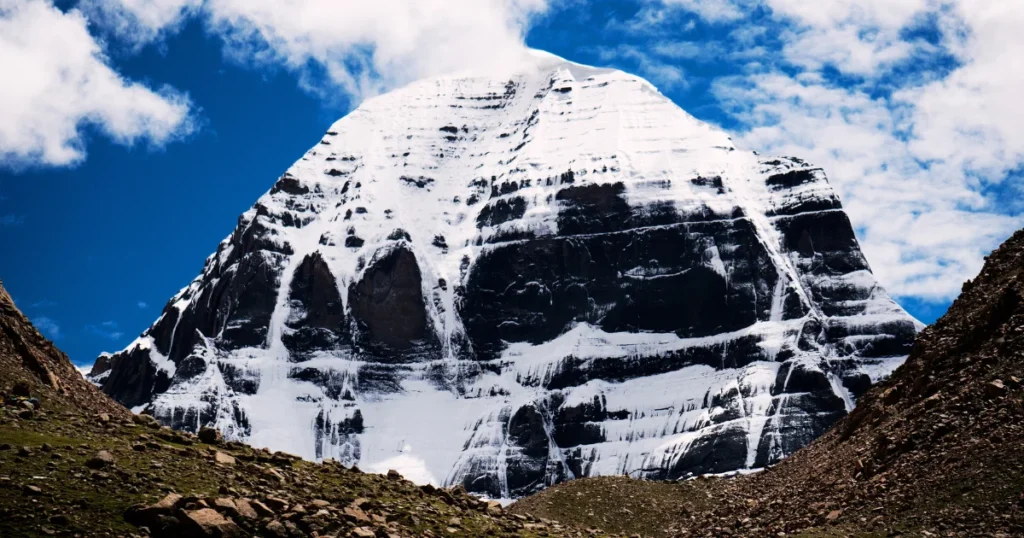
Nestled in the heart of the mighty Himalayas, Mount Kailas is the home of Lord Shiva and Goddess Parvati, along with Devtas, Munis, Yakshas, Yogis, Ganas, Gandharvas and Siddha Purushas according to Hindu scriptures. There is no temple on Kailas, but the mountain itself is the abode of Shiva and is therefore considered most sacred. For devotees, the significance of the KMY lies in being able to visit Manasarovar Lake, dip their feet in its water, sprinkle water on their head (taking a full bath is not allowed), have a good darshan and view of Mount Kailas, and if possible, complete the outer parikrama or kora (circumambulation) of Kailas and have a darshan of the mountain from all directions-south, west, north and east.
At the same time, Lake Manasarovar and Mount Kailas hold significant importance in Buddhism, Jainism, and Tibetan traditions. While Hindus regard it as the abode of Shiva, Tibetan tradition refers to Mount Kailas as Mount Meru, which is considered the cosmic axis connecting the heavens and the earth. Jains see it as where Rishabhadeva, the first Tirthankara, attained salvation. Mount Kailas is also revered as the Ashtapada, the eight steps symbolising the path to spiritual enlightenment.
Focusing on Hindus, this rich background is why the KMY is not seen as just another spiritual or hiking trip but as a once-in-a-lifetime opportunity to visit the world’s holiest mountain, regarded as the “Stairway to Heaven,” and return fully enlightened, thankful, compassionate, and forgiving.

There are many ways to do the Yatra. You can apply through the Ministry of External Affairs (MEA), the official government route. However, this option permitted only 750 yatris in 15 batches this year, and you must be fortunate enough to be selected in the lottery and meet the health and other criteria set by the ministry. The ministry also stipulates the age limit between 18 and 70 for undertaking this Yatra. Otherwise, you can go through private operators via Kathmandu.
I opted for the September batch of Yogi Trails’ Kailas Yatra, which commenced from Kerala on September 5 and concluded on September 19. On September 6, I flew from Mumbai to Kathmandu and joined a group of yatris from Yogi Trails, mainly from Kerala. The entire yatra was themed “Kaladi to Kailas,” retracing the footsteps of the revered Guru Adi Shankaracharya, who began his journey of discovery from Kaladi in Kerala to Mount Kailas.

Since we followed the Kathmandu route, the Yatra involved reaching Kathmandu, travelling by road to Manasarovar, doing the outer parikrama of Mount Kailas on foot or with a pony’s help, and then returning to Kathmandu by road within 10 days. The outer Kailas parikrama covers 52 km, starting from Tarboche and passing through places like Yam Dwar, Dirapuk, Dolma La pass, Zuthulpuk, and reaching Chongdo, which takes about 2.5 days. It is important to note that one cannot climb Mount Kailas but can only do a parikrama of it, which Hindus do in the clockwise direction. The outer parikrama route encircles the entire base of the mountain at high altitude and in rugged terrain. The highest point on the path is the Dolma La Pass, at 5,630 meters/18,471 feet above sea level. The average altitude during the parikrama is around 5,115 meters.
From Kathmandu, we left by road to Nyalam, a quiet border town in Tibet. Sitting at an altitude of 3,450 m, it is a significant climb from Kathmandu’s elevation of 1,344 m, and the initial effects of high altitude are experienced here. Therefore, we are given time to adapt ourselves a bit at Nyalam before moving on to Saga in Tibet. At Saga, a full day is allotted for acclimatisation to the lower oxygen levels and thinner air. I must add here that more than being athletic, acclimatisation to the high altitude is key to the whole yatra.

Saga is at an elevation of 4,640 meters, and as we left Saga, the smooth driveway on well-laid highways in Tibet opened us to new landscapes. Landscapes that gradually changed in hue as we gained altitude and the oxygen level dropped. No longer was the lush green terrain seen on the Kathmandu-Nyalam stretch. Now, the vegetation had shrunk, and the colours faded to yellowish brown. Stretches of snow-capped mountains appeared, offering distant views as the drive through the Tibetan countryside continued.

The drive from Saga to Manasarovar, about 450 km, was very scenic, and being at the same altitude level made it very comfortable. The vast, expansive golden meadow landscapes, adorned by light blue mountains and high-tension transmission lines in symmetry on both sides, along with yaks of all hues, are sights to behold.
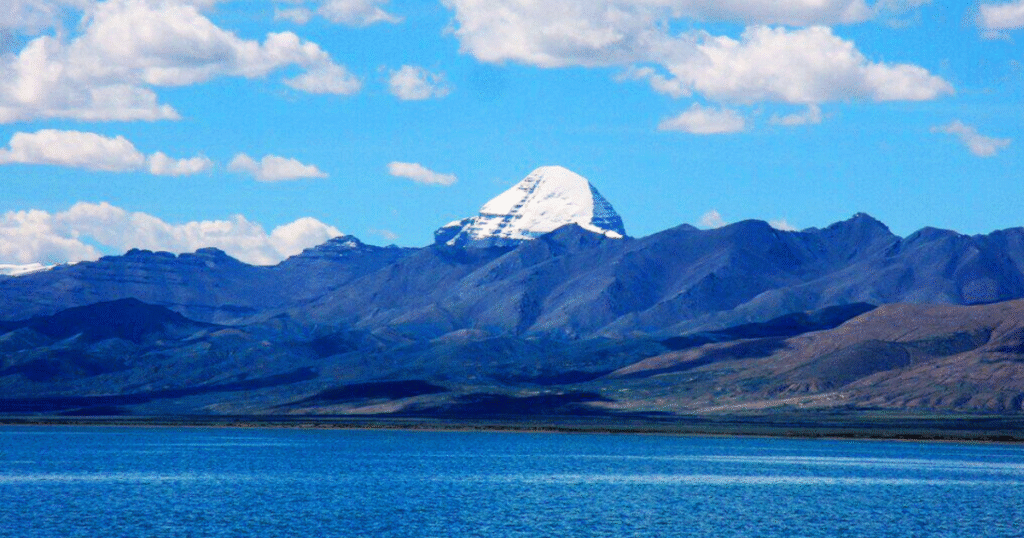
By evening, as we approached Manasarovar, the excitement among all of us was palpable. Although we would have the chance to see Mount Kailas from different angles and closer up in the coming days, viewing it from a distance for the first time felt special. Soon, we caught the first sight of Mount Kailas’s south view and the blue waters of Lake Manasarovar. On the other side of Mount Kailas, near Manasarovar, was the equally majestic Gurla Mandhata, a mountain in Tibet that is part of the Himalayas and the 34th highest peak in the world.

Within a few minutes, we reached the banks of Manasasarovaram, a dream come true for most of us. For the next hour or so, we immersed ourselves in the experience of being at the world’s highest freshwater lake. The crystal-clear, deep blue water reflecting the snow-clad Mount Kailas and the surrounding peaks is breathtaking. After sprinkling ourselves with holy water and collecting samples in bottles, we moved from Manasarovar to Rakshastal, a crescent-shaped saltwater lake nearby. Legend has it that this is where the Hindu King Ravana penanced and gained his superpowers from Lord Shiva. Its deep saline waters are seen as a counterbalance to the pristine freshwater of Lake Manasarovar, symbolising the existence of opposites in life.
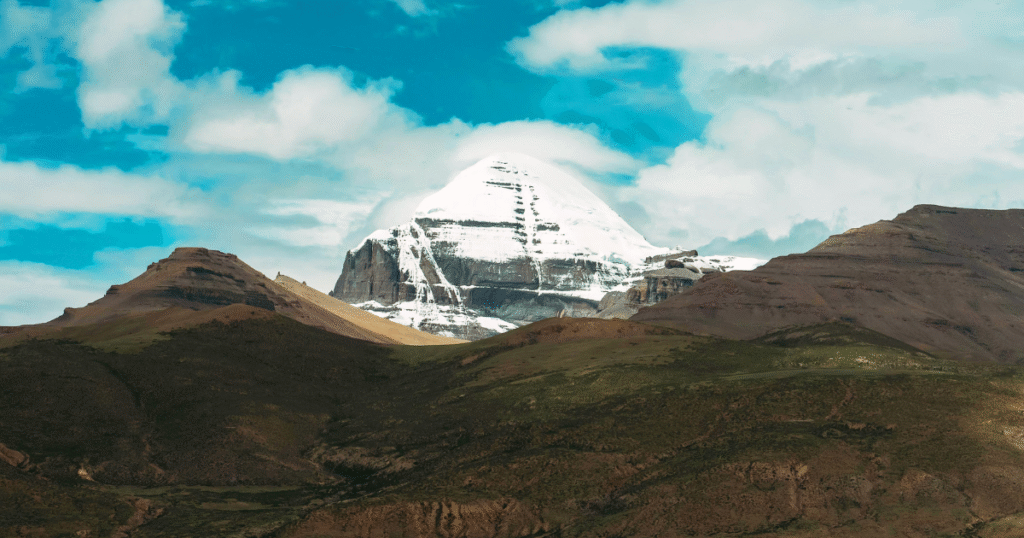
The next day, just after noon, we left Manasarovar for Darchen, about 40 km away, the base camp from where we start the Kailas parikrama. By evening, when the sky cleared, we left for Ashtapad. Ashtapad is a revered site for Jains on the south face of Kailas in Tibet. It is the place where the first Jain Tirthankara, Rishabhdeva, attained salvation. The clear weather gave us a good close darshan of Mount Kailas and Nandi Parvat. We duly offered the soil we had brought from Kaladi at the feet of Kailas, and collected soil from there to deposit at Kaladi.
We checked out and left the hotel at Darchen in the morning the next day to reach Tarboche, the starting point of the outer Kailas parikrama. One can complete the parikrama on foot or with a pony’s help. This is where sherpas and ponies wait and are assigned strictly through a lucky draw system. There is no way to select your own sherpa or pony; it is solely decided by the lucky draw.

As we started the outer Kailas Parikrama or Kora, the first stop was Yam Dwar, which is almost the starting point of the parikrama. One passes through a small door believed to be guarded by Lord Yama himself, the guardian of Lord Shiva’s abode. Tibetan people also revere this place; wherever Tibetans hold reverence, colourful, attractive prayer flags are often tied around the area. As part of wish-making practices (mannat), you will see pebble stones arranged in various shapes and sizes around these places.
The parikrama path, spanning about 14 km from the starting point to Dirapuk, is relatively easier on the first day. The entire route is scenic, with a clear blue sky and the sounds of the Lha Chu River flowing nearby enhancing the journey. The altitude gradually rises from 4,670 m to 4,900 m. The water is crystal clear, and the reflection of the blue sky on its surface makes it a photographer’s paradise. By evening, after walking for about 6 hours with hydration breaks, we reached our overnight stop-Dirapuk Monastery.

At Dirapuk, we settled into our dormitory-style accommodation, which offered a very close view of the north side of Kailas. During sunset, as the sun’s yellow rays stared down on the snow-covered Kailas, we briefly immersed ourselves in the golden hour. It was time to go to bed early that night, as the most challenging part of the parikrama awaited us the next day. You need to cover 22 km, reaching the highest point of the journey at 5,630 m at Dolma La Pass, followed by a steep descent.
The Sun rises quite late in these parts of the world at this time. It’s completely dark until about 8 AM, and during those early hours, we started walking for the second day of the parikrama. We began at 8:00 AM with a steep climb to Dolma La. The terrain is treacherous and slippery, with snow-covered rolling stones providing little grip. We used the help of a pony on this stretch and reached the highest point, where we were warned about a shortage of oxygen in two hours. None of us needed extra oxygen that day, and we managed to climb the peak fairly easily. Once again, the entire climb was scenic, passing by Shivasthal, with stretches of snow-covered mountains.

Once you reach Dolma La, it is a steep downhill climb along narrow paths everyone must walk. Because the terrain is very slippery, even pony riders have to do this walk themselves. As we turned left from Dolma La, we saw the Gauri Kund, a sacred freshwater pond, the smaller Ganesh Kund, and then Kuber Kund, which was completely frozen. One of the sherpas quickly trekked down and collected water from the holy Gauri Kund for all of us. While descending, we also got a brief view of the east side of Kailas. After a slow but careful descent for about three hours, we reached the Shapje Datok valley, where we could rest and have our packed lunch.

Continuing the trek across flat terrain for about three hours, we finally reached Zuthulpuk, our stop for the day, after an exhausting second day of parikrama. There was a sense of relief and gratitude as the most challenging segment was completed smoothly for all of us. Imagine what might have happened if it had started raining, as it did the previous evening, with a brief hailstorm hitting the ground. Although we were prepared for rain during the trek, it becomes much tougher on the already slippery terrain when the ground turns slushy and your shoes and clothes get soaked despite all the protection.
We were told that the third day of the parikrama would be relatively more straightforward. It was indeed simpler than the steep climb and descent the previous day, but it was not a complete cakewalk. We left around 7:00 AM, just after tea, and started trekking in the darkness with torchlights. The climb was moderate primarily; the stretch from Zuthulpuk to the final stop in the parikrama – Chongdo – took about two and a half hours to cover roughly 5 km. There was a last steep climb towards the end, but otherwise, it was a reasonably easy segment. By 9:30 AM, we had reached the terminus at Chongdo, where our coach waited for us to return to Darchen. We reached Darchen quickly and had our breakfast. The feeling among everyone was one of fulfilment and gratitude for completing the parikrama successfully and smoothly as planned, without any significant issues such as weather disruptions or last-minute surprises.

Truth be told, I didn’t realise the magnitude of the Yatra when I signed up for it. But today, having completed the trip successfully, I do understand its significance. Kailash Manasarovar Yatra is indeed an arduous but transformative journey one can undertake in a lifetime. The whole trip with the Yogi group was like a family trip with deep bonds built over two weeks. One couldn’t ask for smoother and more convenient travel, and the group was unanimous in feeling that it was indeed blessed.

For a detailed travelogue on the Yatra, you may click here